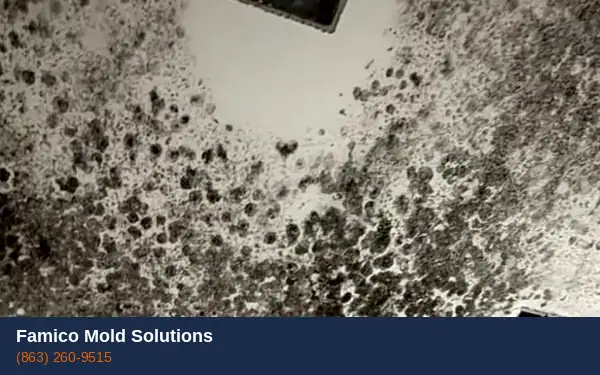
What is black mold and why does it matter
Black mold is the common name for Stachybotrys chartarum. It grows on materials with high cellulose content — drywall, wood, paper — after prolonged moisture exposure. In Haines City, it commonly appears after hurricane flooding, slow roof leaks, or drain line failures where water sat for more than 72 hours.
Stachybotrys produces mycotoxins. These are toxic compounds that affect indoor air quality and cause serious health problems with prolonged exposure. They are not the same as everyday mold allergens. Mycotoxin exposure causes chronic fatigue, headaches, memory problems, respiratory damage, and in severe cases neurological symptoms.
How to identify black mold in your home
True Stachybotrys is dark greenish-black and appears slimy when wet. It grows in patches and gives off a strong, musty, earthy odor. It thrives in areas with persistent moisture — not just occasional condensation. Common locations in Haines City homes include bathroom walls, beneath kitchen and bathroom sinks, behind drywall near AC drain lines, attic decking under leaking roofs, and crawl space floor joists.
Many dark mold species look like black mold visually. Only a surface sample sent to an accredited lab confirms the species. We take samples before starting work so we know exactly what we are dealing with.
Our black mold removal process
- Inspection with moisture meter and thermal imaging camera to map all affected areas
- Surface and air samples sent to accredited lab for species identification
- Containment barriers with negative air pressure machines — spores cannot escape the work zone
- Full PPE including respirators, disposable suits, and gloves throughout the job
- Physical removal of all affected drywall, insulation, and porous materials
- HEPA air scrubbers running throughout — captures spores down to 0.3 microns
- EPA-approved antimicrobial treatment on all surfaces in the work zone
- Post-remediation air test confirms clearance before we leave
- Written clearance report from accredited lab provided to homeowner
Why the moisture source matters
Black mold cannot survive without persistent moisture. Removing visible Stachybotrys without fixing the moisture source — the leaking pipe, the AC drain, the roof — means it returns within weeks. We identify and address the moisture source on every black mold job.
Black mold in Haines City after Hurricane Ian
After Hurricane Ian, Polk County homes reported standing water that took days or weeks to recede. Several Haines City homeowners on Georgene Road noted mold in their AC returns within two to three weeks of initial flooding. Standing water for 72 or more hours creates ideal conditions for Stachybotrys growth behind drywall and under flooring.
If your home flooded during Hurricane Ian or any subsequent storm and you have not had a professional mold inspection, call us. Stachybotrys grows inside walls where you cannot see it. By the time you smell it, it has usually been growing for weeks.